
Stablecoins at a Crossroads: CryptoUK Joins Industry Leaders at Stablecoins Unblocked 2026
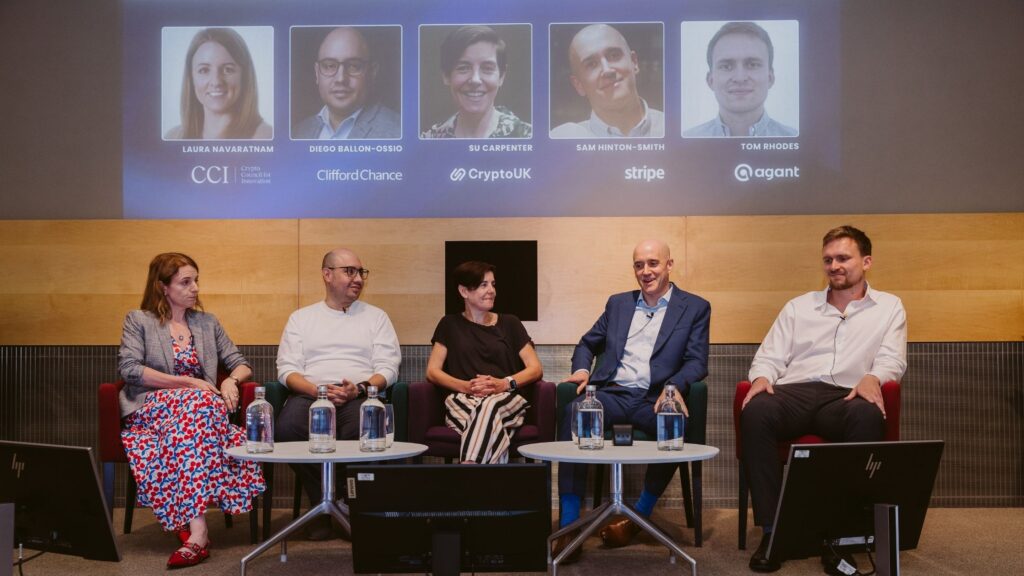
CryptoUK Executive Director Su Carpenter joined policymakers, legal experts and industry leaders at Stablecoins Unblocked 2026, hosted by CryptoUK member firm Clifford Chance in London on 1 July 2026.
The event brought together voices from across the ecosystem at a pivotal moment for the UK market. It took place just days after the Bank of England published its updated framework for systemic stablecoin issuers and immediately after the FCA published its final rules and guidance for the UK’s new cryptoasset regime.
Su was invited to participate in a panel discussion entitled “Stablecoins at a Crossroads: Navigating Law, Policy and Consumer Protection”, alongside Laura Navaratnam, UK Policy Lead at the Crypto Council for Innovation, who moderated the session; Diego Ballon-Ossio, Partner at Clifford Chance; Sam Hinton-Smith, Head of International Public Policy, APAC & EMEA at Stripe; and Tom Rhodes, Chief Legal Officer at Agant.
The discussion reflected both the progress made in recent weeks and the work still required if the UK is to turn regulatory clarity into meaningful stablecoin adoption.
A pivotal week for UK stablecoin policy
The panel took place against a rapidly shifting policy backdrop. The FCA has now published final rules and guidance for the UK’s new cryptoasset regime, giving firms greater clarity on the standards they will need to meet as the sector prepares for authorisation and implementation.
CryptoUK has published a further analysis of the FCA’s final rules, including what is covered, what remains outstanding and what firms should be considering next: FCA Publishes Final Rules for UK Cryptoasset Regime: What’s Next?
For stablecoin issuers and firms building around digital money infrastructure, this provides a clearer regulatory destination. However, as the panel made clear, clarity on paper is only one part of the adoption challenge. The UK also needs a workable authorisation process, proportionate implementation, clear perimeter guidance and policy alignment across regulators, government and HMRC.
Su highlighted the importance of looking beyond the FCA and Bank of England in isolation. Stablecoin adoption will depend not only on prudential rules, backing assets and consumer protection, but also on whether the tax framework supports real-world use cases. In particular, she noted that if every stablecoin payment creates a tax reporting event, the practical burden could quickly become unworkable for businesses and consumers.
This is why HMRC’s work on stablecoin taxation is such an important part of the wider regime. CryptoUK’s Tax Working Group continues to play an important role in helping identify the practical issues that must be addressed if stablecoins are to be used effectively for payments, settlement and wider financial services activity.
Industry engagement is shaping better outcomes
A clear theme from the panel was that industry engagement has had a tangible impact.
The Bank of England’s updated approach to systemic stablecoins marked a significant shift from earlier proposals. Most notably, the Bank moved away from user-level holding limits, which had been widely criticised by industry as operationally difficult, commercially restrictive and potentially damaging to adoption. Instead, the Bank has moved towards an issuance-level guardrail, while also revising the proposed reserve composition for systemic stablecoin issuers.
CryptoUK has set out further analysis of the Bank’s updated position here: Bank of England Stablecoin Statement Marks Progress, But the Viability Test Remains
Su welcomed this movement, noting that CryptoUK and its members had spent months consolidating practical industry feedback and setting out why holding limits would be difficult to implement in practice. The shift was therefore not only a positive policy development, but also evidence that structured engagement between regulators and industry can lead to more workable outcomes.
This matters because the UK is still at an early stage in the development of a sterling stablecoin market. Dollar-denominated stablecoins continue to dominate global activity, and the UK will need to create the right conditions if it wants sterling-denominated digital money to become a credible and useful part of the financial system.
The panel’s message was not that regulation alone will create adoption. Rather, regulation can remove barriers, build confidence and create the conditions in which credible firms can invest, build and scale.
Adoption depends on more than regulatory approval
One of the most important points raised during the discussion was the distinction between becoming a compliant market and becoming a preferred market.
The UK now has the foundations of a comprehensive cryptoasset regime. But whether firms choose to build, launch and scale stablecoin services in the UK will depend on how that regime is implemented.
The panel explored several areas where further work is still needed:
Perimeter clarity. Firms need confidence about which activities require authorisation, especially where regulated financial services providers, software developers, merchants and infrastructure providers interact across complex stablecoin payment flows.
Cross-border use cases. Stablecoins are inherently global. Use cases such as cross-border payroll, treasury management, international settlement and access to global liquidity depend on the ability to move value across jurisdictions. If the UK framework is too restrictive or unclear for international models, firms may struggle to serve UK users competitively.
Implementation and authorisation. The FCA’s authorisation process will be critical. A pragmatic, well-resourced and clearly communicated process will help firms prepare. A slow or uncertain process risks undermining the benefits of the final rules.
Support for smaller and scaling firms. Su stressed that the transition from the existing MLR framework to the full FSMA regime will be especially challenging for smaller, innovative firms. The cost, resource and operational burden of authorisation could create pressure for consolidation unless proportionate support and guidance are available.
This is a vital point for the UK’s competitiveness. A successful regime should not only accommodate the largest global institutions; it should also preserve space for innovative UK-based firms to grow.
Tax remains a final piece of the puzzle
Su also used the discussion to reinforce the importance of stablecoin tax treatment.
For stablecoins to function effectively as a payment or settlement instrument, the tax framework needs to reflect their economic substance. If the tax treatment creates disproportionate reporting obligations for routine payments, adoption will be limited no matter how strong the regulatory framework becomes.
The UK has an opportunity to take a thoughtful approach here. HMRC’s engagement with industry is welcome, and CryptoUK’s Tax Working Group has been actively considering how the tax treatment of stablecoins can better support practical use cases while maintaining appropriate safeguards.
Getting this right could place the UK in a stronger global position. As Su noted during the discussion, the tax treatment of stablecoins is not a side issue; it is a core part of whether the wider regime can work in practice.
From policy development to implementation
The panel captured a broader shift in the UK debate. For several years, the sector has been responding to discussion papers, consultations and draft proposals. The focus is now moving from policy development to implementation.
That shift brings new challenges. Firms must prepare for authorisation, understand the permissions they may need, assess operational impacts, engage with regulators and make strategic decisions about whether and how to build in the UK.
For CryptoUK, this next phase reinforces the importance of continued industry collaboration. Member input has already helped shape more practical outcomes, including on issues such as stablecoin holding limits, reserve composition, tax treatment and proportionality. As implementation begins, that collective voice will remain vital.
CryptoUK members have access to policy working groups, regulatory engagement opportunities, member-only events, roundtables and a network of firms supporting the UK’s cryptoasset sector through this next phase. Organisations interested in contributing to this work can learn more about joining CryptoUK.
The UK has made meaningful progress. The regulatory direction is clearer, the Bank of England has shown willingness to respond to industry concerns, and the FCA’s final rules provide firms with a stronger foundation for preparation.
But adoption will depend on what happens next.
If the UK can combine clear rules with pragmatic implementation, proportionate authorisation, workable tax treatment and sustained political support, it has an opportunity to build a stablecoin framework that supports innovation, protects consumers and strengthens the UK’s position as a global financial centre.
CryptoUK will continue working with members, regulators, policymakers and industry partners to help ensure that opportunity is realised.
For those who were unable to attend Stablecoins Unblocked this year, the organisers have already opened a waitlist for the 2027 event. You can register your interest here: Stablecoins Unblocked 2027 waitlist.