
An interview with WhiteBIT Founder Volodymyr Nosov: “Clear Regulation Can Make the UK a Stronger Global Crypto Hub”
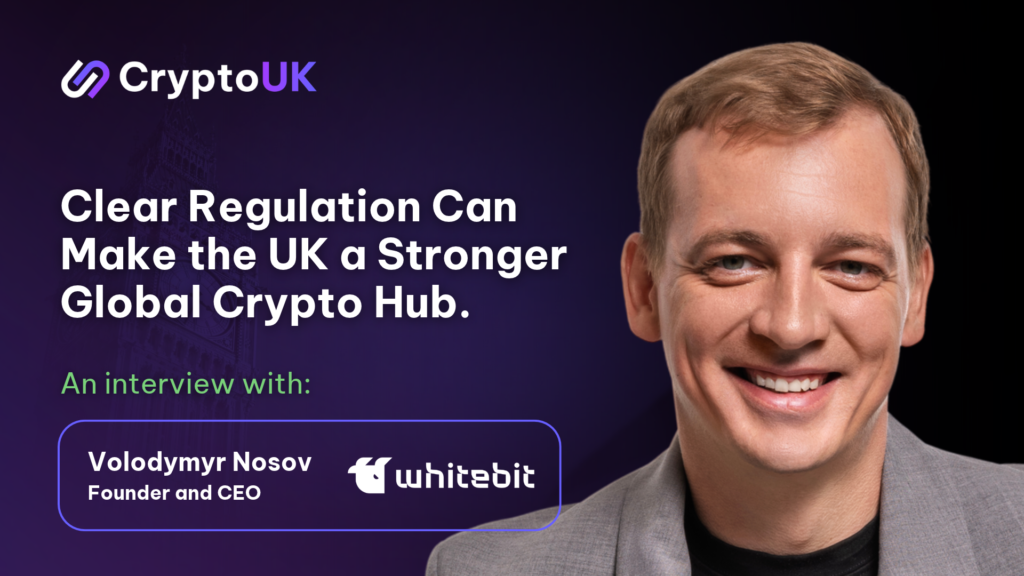
Following the launch of WhiteBIT UK this year, Volodymyr Nosov, Founder and CEO of WhiteBIT and Non-Executive Director of WhiteBIT UK, joined CryptoUK Board Director Su Carpenter to discuss the company’s growing presence in the UK, the evolving regulatory landscape, consumer trust, institutional demand, and the future of digital assets in Britain.
1. Why is the UK an important market for WhiteBIT, and what does the launch of WhiteBIT UK allow you to offer that is different from serving UK users through a global platform?
Volodymyr Nosov: The UK is one of the most important financial hubs in the world and a critical bridge for global liquidity. It is a market defined by sophisticated retail investors, world-class institutional infrastructure, and a regulator in the FCA that sets a global benchmark for rigor. Our expansion into the UK is an important step in WhiteBIT’s international growth, giving us the opportunity to help shape the future of finance while operating within one of the world’s most established financial and regulatory environments.
The scale of the opportunity is also reflected in consumer adoption. According to the Financial Conduct Authority’s 2025 Cryptoassets Consumer Research, awareness of cryptoassets remains high at 91% among UK adults, while around 8% currently hold cryptoassets. This tells us that digital assets are already firmly established in the public consciousness, while there is still significant room for responsible growth as the regulatory framework matures.
The launch of WhiteBIT UK under the section 21 regime enables us to provide a more localised experience, tailored to the UK market, its regulatory framework and customer expectations. It also reflects our future long-term commitment under a directly authorised route to building trust and operating as an onshore partner for both individuals and institutions.
Serving UK users through a dedicated entity – WhiteBIT UK – fundamentally changes the value proposition compared to a global platform. A local entity provides direct, convenient access to GBP banking rails (Faster Payments), bespoke local customer support, and tailored product suites designed with UK users in mind.
2. The UK is moving from a narrower financial promotions and AML-focused regime toward a fuller cryptoasset framework. How is this changing what users and institutions expect from exchanges?
Volodymyr Nosov: In my view, retail consumers are increasingly looking for clear disclosures, fair treatment, and stronger protection against predatory practices. At the same time, I believe institutional players — including hedge funds, asset managers, and family offices — place growing importance on operational clarity. More broadly, we are seeing expectations for crypto exchanges move closer to the standards associated with traditional financial services, particularly around transparency, governance, consumer protection, and accountability.
A comprehensive regime moves the conversation away from basic AML compliance toward market integrity: market abuse monitoring, robust custody standards, conflict of interest management, and capital adequacy.
Exchanges that have systematically invested in compliance from the very beginning of their operations now have a significant advantage in this environment, as strong compliance provides the foundation for trust, wider adoption, and closer integration between digital assets and traditional finance.
3. FCA research shows that centralised exchanges remain the most common route into crypto for UK users. What do you think users are looking for from an exchange today: access, simplicity, trust, consumer protection, security, liquidity, regulation, or something else?
Volodymyr Nosov: In my view, it is no longer a choice between these elements; today, users increasingly look for a combination of accessibility, simplicity, security, and trust. While access and simplicity were key priorities in the earlier stages of crypto adoption, I believe trust — supported by strong security and greater transparency — is becoming increasingly important as the market matures.
This direction is also reflected in the FCA’s Cryptoassets Consumer Research 2025, which provides insight into how UK consumers engage with cryptoassets and what influences their decisions. According to the research, 26% of non-users say they would be more likely to enter the market if cryptoassets were fully regulated. In our experience, this broader shift towards trust is also reflected in growing attention to asset protection, liquidity, institutional-grade custody, and intuitive products.
4. For retail users, what does a good UK crypto experience look like in practice — from GBP funding and instant conversion to trading, analytics, education and risk awareness?
Volodymyr Nosov: A good UK crypto experience should enable users to fund their accounts in GBP, convert and trade easily, and access clear analytics without unnecessary complexity. Education, transparent fees and practical risk information should be integrated directly into the platform, helping users make informed decisions.
5. For institutional clients, where are you seeing the strongest demand in the UK: liquidity, market-making, token listings, custody, Crypto-as-a-Service, API connectivity, or broader digital asset infrastructure?
Volodymyr Nosov: All these components are important, and for the client, they need to work together as an integrated whole.
An institution rarely needs just an account on an exchange. It needs reliable liquidity, predictable execution, APIs, reporting, risk controls and an infrastructure that can integrate into existing systems. Liquidity remains fundamental because institutions operate at a scale where execution quality matters.
At the same time, we are seeing the industry move towards infrastructure models in which companies do not necessarily want to build every crypto capability internally. This is where Crypto-as-a-Service becomes interesting: an existing fintech, payment company or financial institution can integrate digital asset functionality through established infrastructure rather than recreate exchange technology, wallet infrastructure and liquidity connectivity from zero.
So I would not describe institutional demand as one vertical. The bigger trend is convergence. Institutions increasingly want a single infrastructure layer connecting liquidity, trading, APIs and digital asset services.
6. As firms prepare for FCA authorisation, what do you think will distinguish firms that are well positioned for the new regime from those that may face greater challenges during the authorisation process?
Volodymyr Nosov: Documentation alone will not be enough.
The FCA has been very clear that firms seeking permission under the new regime will need to meet its minimum standards and demonstrate that they can continue to meet them. The proposed framework now covers areas including safeguarding, conduct standards, prudential requirements, trading platforms, disclosures and market integrity.
The firms best positioned for authorisation will therefore be those where compliance is already part of the operating model: clear governance, credible senior management, effective AML controls, robust custody arrangements, operational resilience, cybersecurity, capital planning and strong internal risk management.
7. WhiteBIT EU recently secured MiCA authorisation in Austria, marking an important step in its regulated European growth strategy. How does operating under MiCA shape WhiteBIT’s approach to compliance, user trust and market expansion, and what operational challenges can arise when firms need to comply with both an EU-wide regime and a separate UK framework?
Volodymyr Nosov: For us, obtaining MiCA authorisation in Austria is more than just a licence. In my view, it demonstrates WhiteBIT’s commitment to high European standards in compliance, security, governance, and user protection. I believe this can help strengthen trust in our platform and provide a solid foundation for further growth across Europe. At the same time, it is worth noting that MiCA authorization specifically applies to the EU market, while UK users are subject to relevant local standards and regulatory frameworks.
At the same time, operating under different regulatory frameworks is not new for us. WhiteBIT operates across multiple international markets, each with its own rules, including European countries, Turkey, Australia, and Latin America. We combine WhiteBIT’s global standards with strong local expertise, with local teams responsible for meeting regulatory requirements in their respective jurisdictions.
Therefore, operating under MiCA in the EU and a separate regulatory framework in the UK is part of our established international model. It requires resources and strong local expertise, but it also gives us an important advantage — the ability to grow globally while complying with the rules of each market.
8. Stablecoins are becoming central to the policy debate in the UK, the EU and the US. What practical role do you think regulated stablecoins could play for consumers, businesses and cross-border payments?
Volodymyr Nosov: Stablecoins are the bridge that transforms blockchain into a foundational global payment rail. They can make cross-border payments and settlement significantly faster and more efficiently than traditional banking infrastructure, while fully backed, fiat-pegged stablecoins can enable near-instant settlement and help businesses use working capital more efficiently.
For corporate treasury and B2B payments, they allow companies to settle transactions with suppliers globally, 24/7/365, reducing friction associated with FX conversion and traditional banking hours.
To unlock this potential, regulatory clarity is paramount. Frameworks like MiCA in Europe and the UK’s upcoming regime for fiat-backed stablecoins are designed to establish clear requirements around reserves, asset segregation, redemption, and oversight, helping reduce risks and strengthen confidence in stablecoins as part of the broader financial infrastructure.
9. Trust remains an important factor in wider adoption. What standards should users expect from exchanges around custody, safeguarding, cybersecurity, market integrity and transparency?
Volodymyr Nosov: The standard should be very simple: an exchange should be able to explain how it protects your assets before it explains how many products you can trade.
First is custody. There must be clear controls around private keys, access permissions, asset segregation and the movement of funds.
Second is cybersecurity. Exchanges are part of financial infrastructure, so security has to be continuous: system monitoring, access management, penetration testing, incident response and operational resilience.
Third is market integrity. Users should expect transparent rules for listings and trading, controls against manipulation and conflicts of interest, and reliable market data.
And finally there is transparency. Users need to understand who operates the service, which jurisdiction they are dealing with, what the terms are and what happens to their assets under different scenarios.
This direction is also visible in regulation. MiCA establishes organisational, operational and prudential requirements for cryptoasset service providers and includes rules addressing market abuse and IT security. In the UK, the forthcoming UK cryptoasset regulatory framework includes dedicated safeguarding requirements for cryptoasset custodians, as well as rules for trading platforms, transparency and prudential resilience.
For me, security is not a feature of an exchange. It is the foundation on which every other feature depends.
10. Looking ahead to the UK’s full cryptoasset regime, what would success look like for WhiteBIT UK, for UK users and for the wider digital asset sector?
Volodymyr Nosov: For us, success means WhiteBIT UK becoming a long-term participant in the UK financial market and a go-to platform for digital assets for both individuals and institutions. We want to build a brand that is associated with reliability, security, and innovation in the UK.
But our ambition goes beyond the growth of WhiteBIT UK itself. We want to help make digital assets an integral part of the UK financial landscape — a trusted, accessible, and well-established part of the modern financial system.
11. As WhiteBIT expands its UK presence, why is it important to be part of industry bodies such as CryptoUK, and how can collective engagement help build trust, support responsible innovation and strengthen the UK’s position as a digital asset hub?
Volodymyr Nosov: Crypto regulation cannot be designed effectively by regulators or industry in isolation.
Regulators understand the policy objectives: consumer protection, market integrity, financial stability and financial-crime prevention. Industry understands how blockchain infrastructure operates in practice, how markets behave and so on.
The best frameworks come from bringing those perspectives together.
That is why organisations such as CryptoUK matter. They create a structured dialogue between companies, policymakers, regulators and the wider financial sector. Importantly, they also help the industry move beyond commercial interests and towards establishing common standards.
For WhiteBIT, being part of that conversation is a responsibility that comes with entering the UK market. If we want the UK to remain a global digital asset hub, the industry must share its expertise, support high standards, and engage constructively in shaping regulation.
The UK already has many of the ingredients: deep capital markets, global financial expertise, strong fintech talent and increasingly clear regulation.
The next step is collaboration. Because sustainable leadership in digital assets will not be built by one exchange, one regulator or one piece of legislation. It will be built by an ecosystem that users can trust.